 Article
A Bride Slapped Her Groom’s Mother. Then The Bill Came Due.
The phone rang at 2:47 a.m., and I knew before I touched it that nothing good comes through a screen at that hour.
My bedroom was cold.
The floor bit through my socks when I swung my feet down, and the old radiator in the corner clicked like a tired metronome.
Outside my little ranch house, wind dragged dry leaves across the driveway.
The blue light from my phone washed the ceiling in a color I had learned to hate during thirty-five years in criminal investigations.
It was the color of bad news arriving politely.
“Grandma…” Ethan whispered.
I sat up before I was fully awake.
He was sixteen, taller than me now, old enough to borrow my pruning shears and pretend he did not still like the grilled cheese I made with too much butter.
But in that one word, he was seven again.
He was the little boy standing on my front porch with a scraped knee, muddy sneakers, and a backpack too big for his shoulders.
“I’m at the precinct,” he said.
His voice was so low I could barely hear it over the radiator.
“Chelsea hit me with a candlestick. My eyebrow is bleeding… but she told them I shoved her down the stairs. Dad believes her. Grandma, I’m scared.”
There are moments in life when panic wants to take the wheel.
Mine reached for it.
Training got there first.
By 2:51 a.m., I was in jeans, worn sneakers, my old gray sweater, and the plain coat I kept by the door.
My hands did not shake while I found my keys.
They did not shake while I locked the house.
They did not shake while I backed out of the driveway under a sky black enough to swallow the streetlights.
That steadiness was not courage.
It was habit.
For thirty-five years, my job had been walking into rooms where someone was lying and someone else was bleeding.
You learn to move before the fear can make a home in your bones.
Ethan’s mother died when he was seven.
After the funeral, he started spending weekends with me.
At first, my son said it was just until things settled down.
Then one weekend became two.
Then Saturdays became the day Ethan would come through my back door without knocking, drop his sneakers on the mat, and ask if I had cheese slices.
He watched old detective shows on my couch.
He fell asleep halfway through the endings.
He left fingerprints on my kitchen window and drawings on my refrigerator.
He learned that grief could sit at the table with us, but it did not get to eat first.
When my son remarried, I wanted to believe Chelsea would be good to him.
I truly did.
I gave her room to be new.
I gave her birthdays.
I gave her school pickups.
I gave her Thanksgiving seats at my table and quiet forgiveness for the small cold things she said when she thought I was too old to notice.
That was my first mistake.
Not the kindness.
The underestimating.
Some people do not see trust as a gift.
They see it as access.
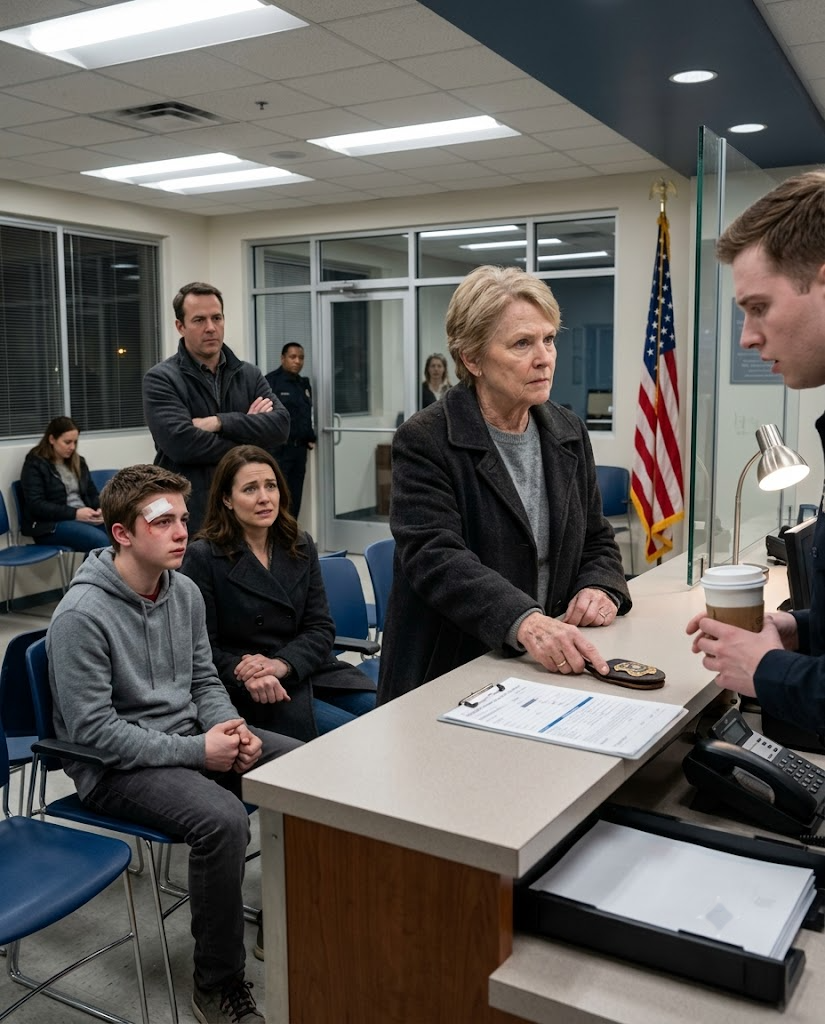
The precinct lobby smelled like burnt coffee, floor cleaner, and damp wool coats.
Fluorescent lights hummed over plastic chairs arranged in rows that had seen too many long nights.
A small American flag stood near the front desk, its gold fringe barely shifting each time the heater kicked on.
A printer coughed paper into a tray.
A young officer stirred sugar into a paper coffee cup.
The desk officer looked up when I walked in, and I watched him do what people had done since I turned sixty.
He measured the gray hair.
He measured the plain coat.
He measured the slow walk.
Then he decided I was a tired grandmother.
“Can I help you?” he asked.
“Ellen Stone,” I said. “I’m here for my grandson.”
The name reached him a second before the badge did..
I slid it across the counter.
The leather was old and soft from years in my coat pocket.
His eyes dropped to it.
Then his face went pale.
“Stone… as in Commander Stone?”
“Retired,” I said. “Not dead.”
He swallowed.
“Yes, ma’am. I’m sorry. I didn’t realize.”
The room changed after that.
Not loudly.
Rooms like that rarely do.
But shoulders adjusted.
Eyes lifted.
The young officer stopped stirring his coffee.
A badge is only metal until people remember what you did with it.
I found Ethan in the waiting area.
He was sitting with a white bandage over his eyebrow and dried blood at his temple.
His hands were locked together so tightly the skin across his knuckles had gone pale.
His hoodie sleeves were tugged over his wrists like he was trying to disappear inside fabric.
My son stood a few feet away with his arms crossed.
His jaw was hard.
He had planted himself next to Chelsea like a man guarding the right person from the wrong one.
I loved my son.
That did not make him right.
Chelsea sat in a plastic chair with her legs neatly together, her coat buttoned, and her face arranged in a softness that had been practiced.
There were marks on her arm.
Too neat.
Too available.
Too ready to be seen.
“Ethan attacked me,” she said before I asked a single question.
Her voice trembled in exactly the places a frightened woman’s voice should tremble.
“He’s been out of control for months.”
Ethan looked at me, and the teenager cracked open just enough for the child to show.
“She hit me first, Grandma,” he said. “She’s been hurting me for six months. Dad doesn’t believe me.”
My son snapped, “Mom, don’t start. Chelsea’s terrified.”
I looked at his wife.
She lowered her eyes.
It was perfect.
Too perfect.
Fear is clumsy.
Real fear forgets where to put its hands.
Performance remembers the audience.
I wanted to walk over to Ethan and put my coat around him.
I wanted to tell my son to look at the boy he had raised, not the woman he had married.
Article
 Article
 Article
 Article
 Article
 Article
 Article
 Article
 4K ULTRA HD
![Strawberry’s New Boyfriend & Pregnant Mother’s Sad Story | Part 4 [End]](https://cnd.storycontinue.com/wp-content/uploads/2026/05/Image-400x600.png) 4K ULTRA HD
4K ULTRA HD
 4K
4K
 4K
4K
 4K
4K
 4K
4K
 4K
4K
 4K
4K
 4K
4K
 4K
4K